Imagine Jerusalem at Pentecost.
The streets are crowded with pilgrims. Religious excitement fills the city, but so does political tension. Judaea lives under Roman occupation and Roman soldiers are never far away. From their perspective, large gatherings are not merely celebrations. They can become protests, riots or rebellions.
Now imagine standing among those soldiers when something extraordinary begins to happen.
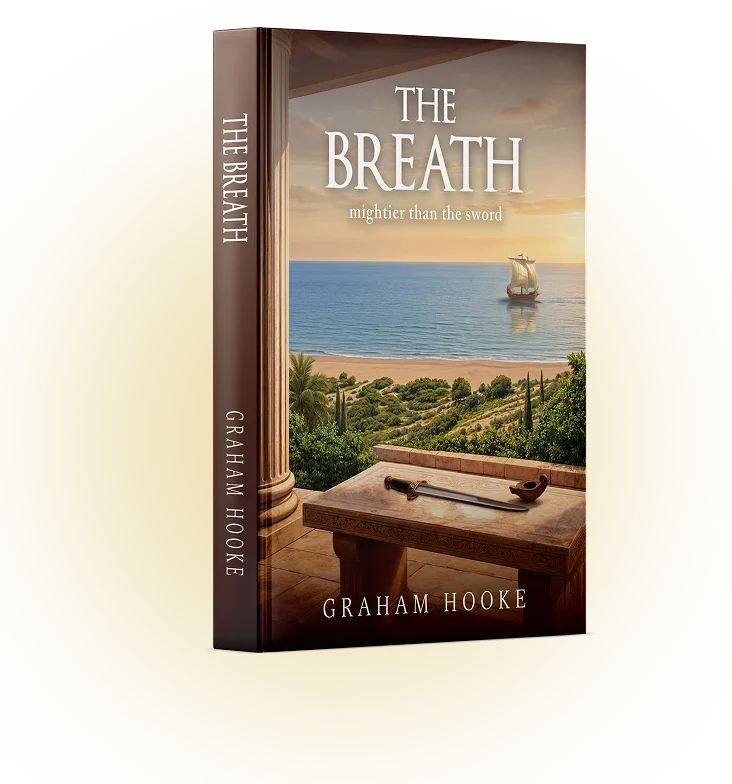
That is the intriguing perspective offered by The Breath: mightier than the sword, a Biblical novel by Graham Hooke.
At the centre of the story is Gaius Octavius Marcellinus, a Roman soldier whose life becomes entangled with the events surrounding the birth and growth of the early Church. He has been trained to see the world through the values of Rome: loyalty, discipline, authority and force.
Then comes Pentecost.
Marcellinus is on duty during Shavuot when Jerusalem is suddenly disturbed by unusual events. He hears of a sound like a powerful wind and encounters crowds drawn together by what is happening among the followers of Yeshua. Peter stands before them and speaks boldly about the crucified Jesus, His resurrection and the promise of God’s Spirit, the mysterious power Marcellinus comes to know as the Breath.
For believers familiar with the Book of Acts, Pentecost is a moment of triumph: the coming of the Holy Spirit and the dramatic beginning of the Church’s mission.
But Marcellinus is not watching as a believer.
He is watching as Rome.
That change of viewpoint gives the familiar story a fascinating new tension.
What would a Roman soldier have thought as thousands responded to Peter’s message? Was this merely another troublesome Jewish sect? A political movement? A threat to imperial order?
More importantly, what happens when a man trained to recognise earthly power encounters a kind of power he cannot explain?
Marcellinus understands the sword. He knows what soldiers can do when crowds become dangerous. Earlier experiences in Jerusalem have already shown him the brutality Roman authority can unleash and have left wounds on his conscience.
But Pentecost presents something entirely different.
No army is marching.
No weapons are being raised.
Yet lives are changing.
People repent. They believe. A new community begins to emerge, united not by military conquest but by faith in Yeshua and the presence of the Breath.
And Marcellinus is unsettled by it.
He does not instantly convert. In fact, one of the novel’s most compelling elements is his resistance. He sees remarkable things, encounters followers of Yeshua and crosses paths with figures including Peter, Gamaliel, Cornelius, Timothy, Luke and Paul. Still, his Roman identity, pride and painful past keep pulling him in another direction.
The result is a deeply personal battle running alongside the historical drama of Acts.
What happens when the apparent enemy begins to wonder whether the people he is watching have discovered something Rome cannot conquer?
That question carries The Breath far beyond Pentecost, through persecution, political upheaval, tragedy and the growth of the early Christian movement.
For readers of Biblical fiction, Pentecost will be familiar territory but Graham Hooke invites us to stand somewhere unexpected: behind the shield of a Roman soldier watching Christianity begin.
And from there, the question becomes irresistible.
Which will ultimately prove mightier: the sword in Marcellinus’s hand or the Breath quietly transforming his heart?
Discover The Breath: mightier than the sword by Graham Hooke (MA PGCE), available on Amazon.
Read the book on Amazon: https://a.co/d/0bUn7xwq