Some people come to faith in a moment.
For others, the journey takes years.
There are questions to overcome, wounds that refuse to heal, disappointments that harden into bitterness and carefully constructed walls that seem impossible to break down. But what happens when someone spends a lifetime resisting God and God does not stop reaching for him?
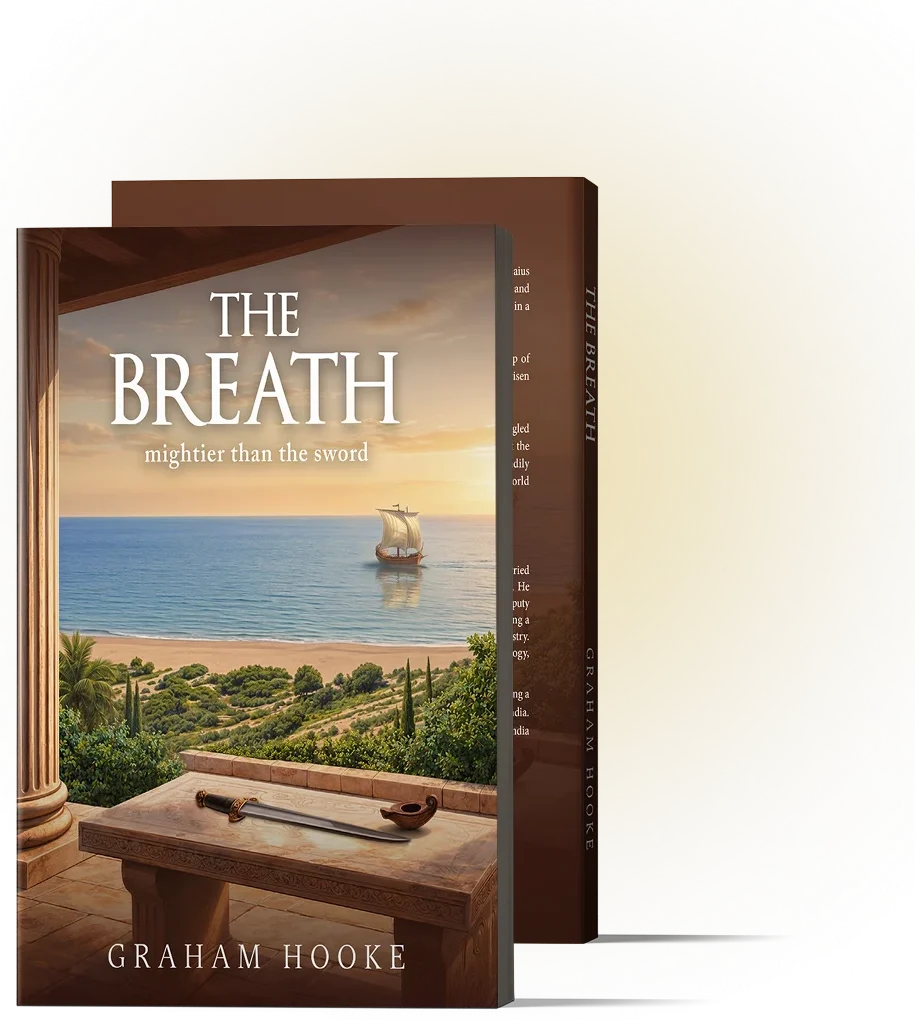
That question lies at the emotional heart of The Breath: mightier than the sword, a Biblical novel by Graham Hooke.
Its central character, Gaius Octavius Marcellinus, is not naturally drawn towards surrender.
He is a Roman soldier.
After the violent loss of his parents, the young Marcellinus carries anger into adulthood and finds an outlet for it in military life. Rome teaches him discipline, strength and obedience. The sword becomes more than a weapon; it represents the kind of power he understands.
But beneath the armour is a man carrying wounds that military victories cannot heal.
When Marcellinus is eventually stationed in Judaea, he finds himself drawn into a world that challenges almost everything he believes about strength, loyalty and truth. He sees Roman brutality firsthand and must confront his own part in it. Then rumours begin spreading about Yeshua of Nazareth, a man who has been crucified, yet whose followers insist that death has not defeated Him.
Marcellinus is sceptical.
Then comes Pentecost.
He witnesses Peter addressing the crowds and encounters the mysterious presence described throughout the novel as the Breath, the Spirit of God moving with a power unlike anything Rome possesses.
Yet witnessing something extraordinary is not the same as surrendering to it.
Marcellinus resists.
That resistance makes his story especially compelling. The Breath does not present faith simply as the result of one dramatic experience. Instead, Graham Hooke takes readers through a decades-long struggle between a wounded man’s desire to remain in control and the God who continues to confront him through people, events, miracles, love and loss.
Peter enters his world. So do Gamaliel, Cornelius, Timothy, Luke and Paul. Again and again, Marcellinus encounters followers of Yeshua whose lives force him to reconsider what true power looks like.
Still he holds back.
Pride gets in the way. So does guilt. Grief complicates everything.
And perhaps that is why Marcellinus feels so recognisably human.
Many people do not reject faith because they have never thought about God. Sometimes they resist because believing would mean facing painful questions. Can the past really be forgiven? Can someone responsible for terrible choices be changed? Where is God when suffering strikes? And is surrender truly strength or weakness?
For Marcellinus, these questions become the real battlefield.
After so many years of resisting the Breath, is change possible for Marcellinus? Faced with grace he can no longer dismiss, can he renounce his pride and replace allegiance to Rome with allegiance to Yeshua?
His sword could defeat an enemy.
It could not defeat guilt.
Rome could teach him discipline.
It could not give him peace.
Only the Breath could reach the places he had spent a lifetime protecting.
That is the invitation at the centre of The Breath: mightier than the sword: a story about faith, but also about resistance; about suffering, but also redemption; and about the extraordinary possibility that no heart is beyond the reach of God, even one that has spent a lifetime saying no.
Discover The Breath: mightier than the sword by Graham Hooke (MA PGCE), a Biblical novel of Rome, faith, struggle and transformation, available on Amazon.
Read the book on Amazon: https://a.co/d/0bUn7xwq