The Breath – Historical Connections Series
Extract:
The rhythmic sound of our boots echoed off the mighty walls of the city as we marched
through the North Gate.
I took a sharp intake of breath.
“This is Jerusalem,” I whispered to no one in particular. To my mother, living in distant
Rome, it was still the centre of Jewish life, a sacred city, home to the mighty Temple which
Herod was building. Though unfinished, it was already one of the wonders of the world.
Mamma would have been so proud to see me now, a Roman legionary, yes, but with
Jewish blood, here to help preserve the peace. I breathed a silent prayer to the gods to
help me honour her memory.
Marching through the narrow, cobbled streets, it wasn’t long before the temple walls
loomed up ahead, reaching into the darkening night sky. Attached to these walls to the
north east of the Temple stood the Antonia Fortress, our barracks and my home for the
next few weeks, months or even years – I did not know.
Gates of ancient cities all have significance, primarily of course as the entrances and
exits through city walls. This makes them specific points of focus but not only in seeing
who is coming and going, or for defence. In ancient Israel they were also the place where
city elders would adjudicate on matters of law as in the case of the Biblical story of Ruth
when Boaz made a transaction which secured her as his wife. (Ruth ch4).
All the current eight gates of the Old City of Jerusalem have been built at different
times down the centuries following the destruction of the city in 70AD. Most do not match
the locations or names of the originals. One exception is the Damascus gate, originally
known as the North Gate or New City Gate, referred to in the extract above.
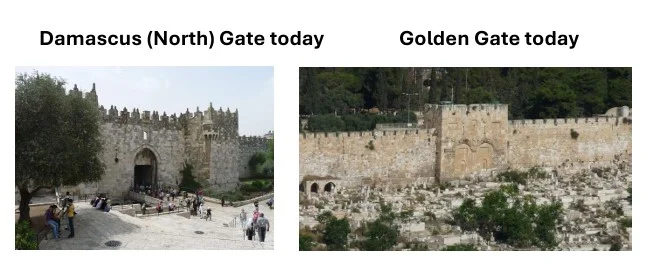
Seven of Jerusalem’s eight gates are open today, the exception being the Golden Gate on the east side of Temple Mount (illustrated) which is the oldest and was sealed by the Ottoman Sultan Suleiman the Magnificent in 1541 to prevent a Jewish Messiah entering Jerusalem as prophesied by the Jews. Additionally, the Ottomans established a cemetery in front of the gate because, according to Biblical laws of impurity this would prevent Elijah, the forerunner to the Messiah, approaching the gate.
Gates of Jerusalem
Jaffa Gate – west side entry from modern Jerusalem
Damascus gate – facing north towards Nablus and Damascus
Zion Gate – south side connecting to Mount Zion
Dung Gate – southeast corner, the closest entry to the Western Wall
Lions’ Gate – eastern entrance from the Mount of Olives
Herod’s Gate – northern wall near the Muslim quarter
Golden Gate – east side of Temple Mount